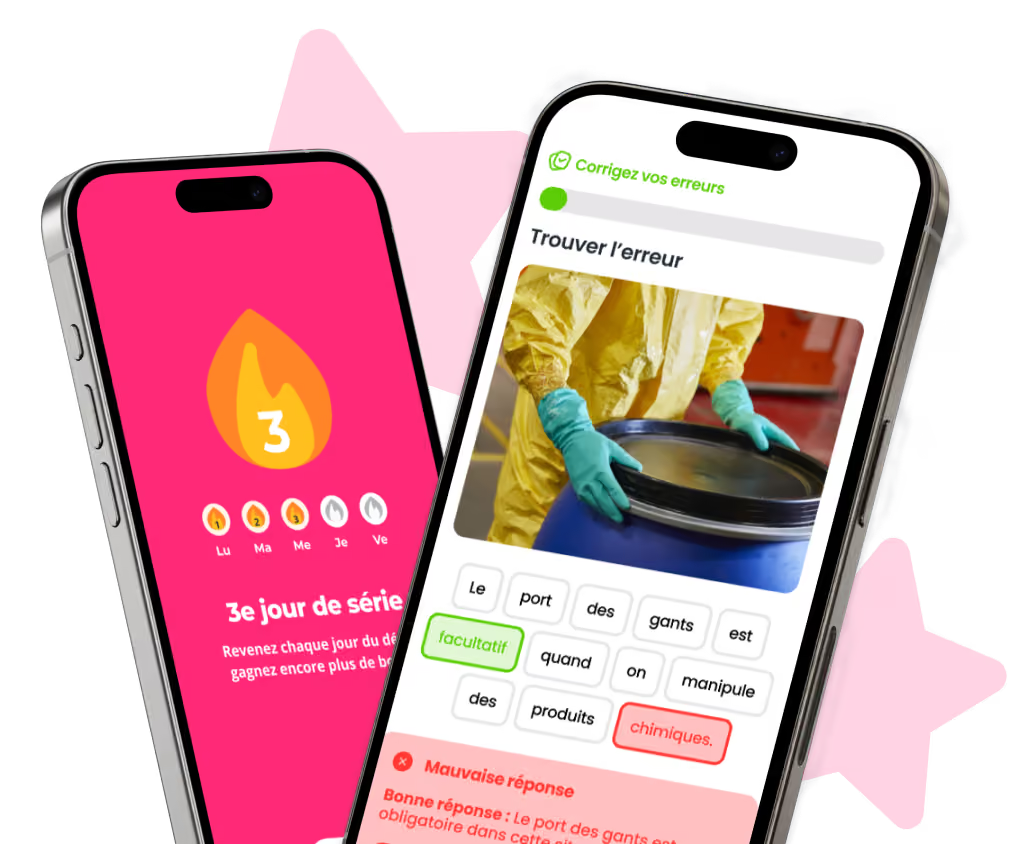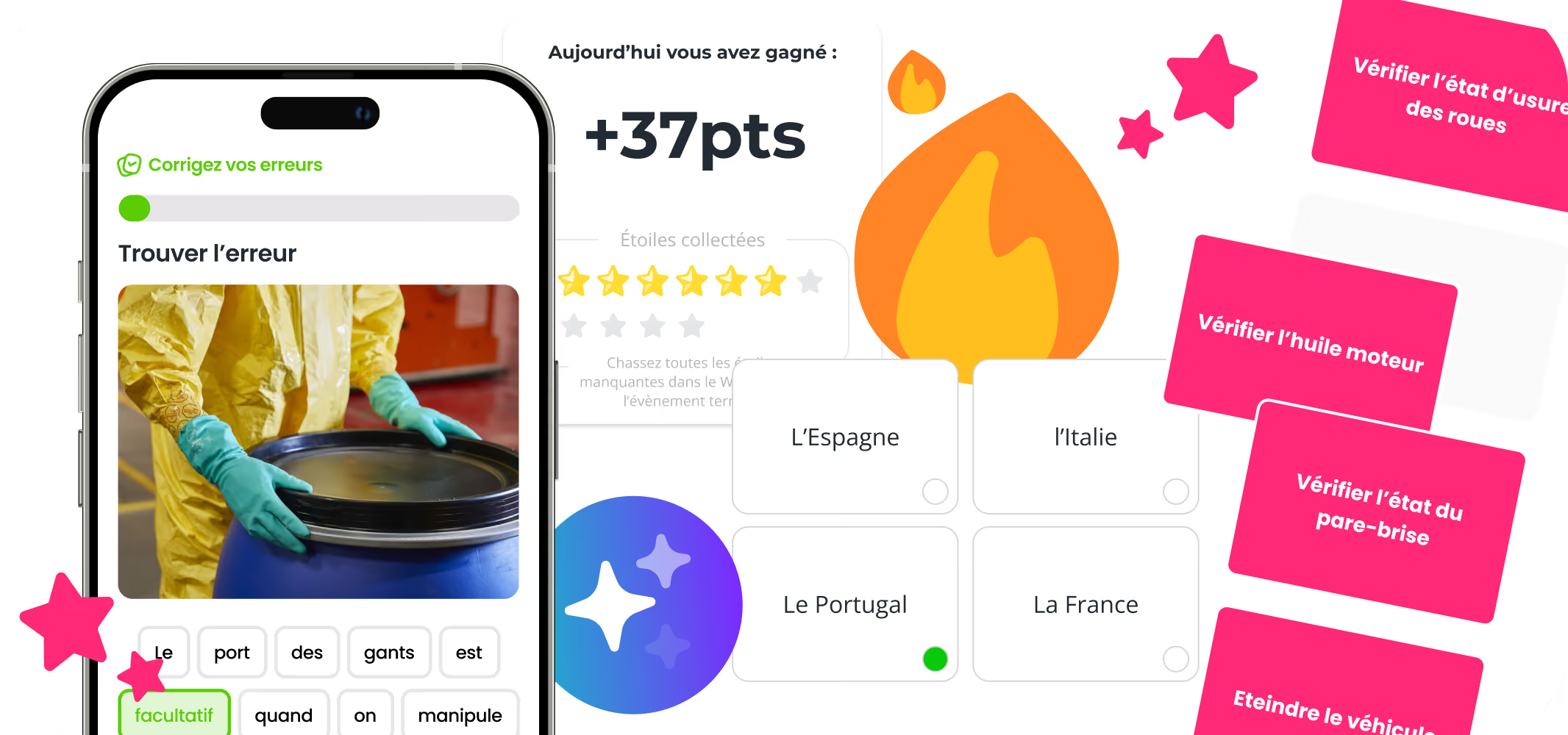







The main benefits of mobile learning are training anywhere and at any time, reaching frontline teams that classroom sessions miss, scaling at almost no extra cost per learner, better retention through microlearning, higher engagement through gamification, and real-time analytics. Together, they shorten the time between training and better performance on the job.
Training teams that are never in the same place at the same time is one of the most concrete challenges training leaders face. Store associates, traveling technicians, multi-site managers and drivers rarely have the availability for classroom sessions that last several hours.
Mobile learning is a way of training employees through short content delivered on their smartphones, where and when they need it. Here are 10 concrete benefits, illustrated with real SPARTED customer examples, to help you assess what it can bring to your organization.
Key takeaways
- Mobile learning removes the constraints of place and time, so deskless employees can train between tasks.
- Once content exists, the cost of each additional learner is close to zero, from 50 to 35,000 employees.
- Short, repeated modules counter the forgetting curve: in Roediger and Karpicke (2006), testing raised one-week recall from 40% to 61%.
- Gamification and analytics turn completion and knowledge gaps into data managers can act on.
- Bridgestone measured a 40% reduction in accidents by year three of its mobile safety program.
1. Train without constraints of place or time
Mobile learning removes the logistical constraint of "where" and "when." An employee can complete a module between two client meetings, on public transportation or during a break, without waiting for a room, a trainer or a shared time slot.
For organizations operating across several time zones or with teams on staggered shifts, this is a structural shift. Ouibus, a French intercity bus company, rolled out a mobile learning program to train its drivers across France on customer satisfaction and first aid, without disrupting their driving schedules.
With 3-minute sessions available at any time of day, 87% of drivers reported improving their skills thanks to the program.
2. How does mobile learning reach frontline teams?
Mobile learning reaches frontline teams by putting training on the device they already carry, so nobody has to leave their post to attend a session. Store associates, dealership technicians and workshop staff are traditionally the hardest employees to train, and as a result they structurally receive less training than the rest of the workforce.
Mobile learning solves this problem at the root. Volvo Penta, facing this challenge with mechanics across its dealer network in France, deployed a mobile learning program on technical product updates and maintenance procedures.
The result: an 85% completion rate and an NPS of 71 among learners, in a population that historically had little access to continuous training.
3. Scale up without multiplying costs
With mobile learning, the marginal cost of an additional learner approaches zero. In a classroom or traditional e-learning model, going from 100 to 5,000 learners means more trainers, more sessions and more licenses. Once mobile content is created, deploying it to 50 or to 35,000 employees across several countries does not fundamentally change the equation.
That is what KENZO achieved with its beauty advisors: the brand engaged more than 35,000 beauty advisors in 20 countries on product knowledge and brand universe, with an average completion rate of 73%. A rollout of this scale would have been impossible with traditional formats.
In the automotive sector, Renault Trucks deployed one of its programs in 46 countries, with 1,300 active players and 300 daily logins.
4. What does learning in the flow of work mean?
Learning in the flow of work is the idea that people learn best when training happens at the exact moment they need the information, inside their workday rather than in a separate course. Josh Bersin popularized the concept in a 2018 article on corporate training, and mobile learning is the format that makes it scalable.
Volkswagen Bank put this principle into practice: a mobile learning module is triggered automatically after each classroom session to reinforce what was learned right away.
This classroom plus mobile combination engaged more than 2,000 active users across the dealer network, on topics as technical as financial and insurance products.
5. How does microlearning make knowledge stick?
Microlearning makes knowledge stick by delivering short sequences that are repeated and tested over time, which is the most effective answer to forgetting. In Hermann Ebbinghaus's 1885 experiments, retention fell to about a third of the material after 24 hours without review. This is the forgetting curve.
Modules of 3 to 5 minutes, repeated at spaced intervals (spaced repetition) and built around quizzes, apply two well-documented effects. According to Roediger and Karpicke (2006), students who were repeatedly tested on a text recalled 61% of it one week later, compared with 40% for those who only reread it.
Renault Trucks, which trains its sales and after-sales teams in 16 countries and 4 languages on content as technical as electric mobility and digital tools, reports a completion rate of 81% on its courses, a rare performance on topics perceived as complex.
6. Drive engagement through gamification
Gamification turns learning into something employees choose to do, rather than something they simply put up with. Completion is a chronic weak spot of traditional e-learning programs, largely because the content is seen as a chore.
Gamification uses badges, leaderboards, challenges, points and levels to change that dynamic. Yves Rocher is a telling example: by rolling out a gamified mobile learning program to train its sales associates on products and selling techniques, the brand saw a 22% increase in new product sales volume, with an 81% average completion rate and sustained daily engagement.
Alpine, for its part, uses friendly competition between sales teams in 11 countries to train on technical product content, achieving 77% completion with an audience that is usually hard to engage on this kind of topic.
7. Personalize courses by profile and need
Mobile learning makes it possible to offer targeted courses, with content adapted to each learner's role, level and priorities. A new hire does not have the same training needs as a ten-year veteran moving into a new role.
Renault Trucks illustrates this logic well: the same program serves sales staff and technicians with separate courses based on each role's business challenges. More than 2,600 active users in the distribution network receive content adapted to their daily reality, whether product knowledge, customer satisfaction or sales management.
SNCF, the French national railway company, used this personalization to train the entire group on highly specific legal topics (GDPR, compliance, safety), adapting content by entity, with 4,245 active players and 40 campaigns deployed.
8. Cut training costs and logistics
Mobile learning cuts training costs by removing travel, room rental and time away from the job for everything related to knowledge transfer. A day of classroom training ties up trainer time, travel expenses, room costs and sometimes accommodation, and replicated across thousands of employees, the budget becomes considerable.
Mobile learning does not replace all in-person training, but it efficiently handles knowledge transfer, procedure refreshers and regular upskilling, which make up a large share of the annual training volume in most organizations.
For companies like Claas, which needs to align the knowledge of 374 sales reps across its dealerships through 9 annual campaigns covering products, taxation, competition and soft skills, mobile training is an obvious economic lever: no travel, no time away from the job, and content updated in real time.
| Criterion | Classroom training | Mobile learning |
|---|---|---|
| Where and when | Fixed room and time slot | Anywhere, at any time |
| Cost per extra learner | Rises with sessions and travel | Close to zero |
| Session length | Half a day to several days | 3 to 5 minutes |
| Reinforcement over time | Rare, needs a new session | Built in through spaced reminders |
| Tracking | Attendance and satisfaction | Completion, scores and gaps in real time |
9. How do you track mobile learning progress?
You track mobile learning progress through the platform's dashboards, which show completion rates by module, quiz scores, individual progress, poorly mastered topics and comparisons between teams or sites. Classroom training offers none of this visibility once employees leave the room.
This data lets training leaders and managers run programs proactively: adjusting content that is not working, nudging a team that is falling behind, identifying employees who need extra support. It becomes critical in retail, where high turnover regularly wipes out part of the training investment.
This fine-grained tracking allowed Bridgestone to monitor its safety program in 10 countries with 5,000 technicians, measuring how knowledge of mechanical, chemical and road risks progressed.
10. Accelerate upskilling and frontline performance
The end goal of mobile learning is more skilled teams, faster, with a measurable impact on performance. By combining accessibility, better retention and analytics, it shortens the time between training and its application in the field.
The results achieved by Bridgestone and its subsidiary FirstStop are the most direct proof. By deploying a safety-focused mobile learning program for its technicians across Europe, the company measured a 40% reduction in accidents by the third year of the program.
This figure reflects more than better knowledge retention: it shows a real change in behavior on the ground, which is the purpose of any serious training.
How SPARTED delivers the benefits of mobile learning
SPARTED is a mobile learning platform built for frontline teams, combining microlearning, gamification and analytics in an experience designed for employees who are geographically dispersed and rarely available for long formats. Its starting point is simple: the most effective training adapts to employees' real constraints, not the other way around.
Its use cases range from retail to the automotive industry, from mass retail to logistics, as well as financial services and cosmetics. What they have in common: mobile employees, technical content to master quickly, and a need to measure the real impact of training beyond the completion rate.
The 10 benefits in this article only fully deliver within a coherent platform, well deployed and built to last. For L&D teams, a well-designed Back Office makes all the difference when it comes to creating, scheduling and tracking campaigns day to day.
Frequently asked questions
What is mobile learning?
Mobile learning is training delivered on smartphones or tablets, usually as short modules that employees can complete anywhere and at any time. It is especially suited to frontline and deskless teams who are rarely in front of a computer.
Is mobile learning effective?
Yes, when it relies on short, repeated and interactive content. Research on the testing effect and spaced repetition shows that regular quizzes over time improve long-term retention, and SPARTED customers such as Volvo Penta and Renault Trucks report completion rates above 80%.
Can mobile learning replace classroom training?
Not entirely. Mobile learning handles knowledge transfer, refreshers and reinforcement very well, while hands-on practice and complex soft skills still benefit from in-person sessions. The most effective programs combine both, as Volkswagen Bank does by triggering a mobile module after each classroom session.
How do you measure the ROI of mobile learning?
Start with learning data (completion, quiz scores, knowledge gaps), then link it to business indicators such as sales, accidents or customer satisfaction. Our guide on measuring mobile learning ROI details the method step by step.
What are the limits of mobile learning?
Mobile learning is not suited to long, deep training or to skills that require physical practice. It also needs engaging content and active follow-up from managers: a module nobody opens has no effect, whatever the format.


Need a mobile learning solution?
A simple, fast and engaging solution, up and running in under 2 weeks.
Discover our solutionTest these benefits with your teams
5 minutes a day, from their phones: SPARTED turns training into a daily habit. Request a demo to see how.
Book a demoGuide How to measure the ROI of your frontline training
Concrete calculations, proven methods and field examples to justify your training investment to leadership.
Read the guide →Need a mobile learning solution?
The simple, social and gamified solution, up and running in under 2 weeks.
Discover our solution