






.jpeg)


Microlearning is a training approach that delivers content in very short sequences, from 30 seconds to 10 minutes, each focused on a single learning objective. In the workplace, it improves engagement and retention, especially for frontline and deskless teams, but it works best as reinforcement rather than as the main format for mastering complex tools.
It has spread as work schedules become more fragmented and it gets harder to pull teams away for full training days. It also draws on what cognitive science has shown about how people learn: limited working memory, the forgetting curve and the value of spaced recall.
This guide covers what microlearning is, what it delivers, where it reaches its limits, and how to roll it out across an organization.
Key takeaways
- A microlearning sequence lasts 30 seconds to 10 minutes and covers one learning objective.
- Its best-established benefit is retention, because short content makes spaced repetition practical.
- Microlearning describes a format (short), mobile learning a device (the smartphone), e-learning a channel (online).
- Mobile is usually the right channel: 91% of US adults own a smartphone, according to Pew Research Center (2025).
- It is a poor primary format for complex software skills, where it works as reinforcement.
| At a glance |
|---|
| Microlearning breaks training down into very short sequences, from 30 seconds to 10 minutes, each focused on a single learning objective. It improves engagement and retention, suits employees who don't work at a desk, and makes it possible to build courses quickly. It is less suited to fully mastering a complex tool, where it works as reinforcement rather than as the main learning format. |
What is microlearning?
Microlearning is a short-format approach to training: one objective per sequence, a few minutes at most. It is distinct from mobile learning and e-learning, even if the three are often combined.
Definition and length of a sequence
Microlearning is the delivery of knowledge in short, frequent micro-sequences, often called nuggets or capsules. Each capsule targets a single learning objective, so it works as a standalone unit that can be viewed without prior context and reused across several courses.
Length is part of the definition. A microlearning sequence lasts between 30 seconds and 10 minutes, rarely longer. This brevity is an instructional choice, not a format constraint: it avoids overloading working memory, which struggles to handle several concepts at once, and it lets training fit into the gaps of a workday.
The underlying principle is to design around the learner rather than around the content. That means making choices: a capsule that tries to say everything is no longer a capsule.
Watch out for a stubborn misconception, though: that learners will naturally seek out their modules whenever they need them. That is not always the case, and microlearning does not mean complete autonomy. Without facilitation or a set rhythm, most self-service programs see little use.
Its four strengths are easy to sum up: conciseness, speed, availability, and adaptability across devices, which lets people learn about any topic using the tools already at hand.
What is the difference between microlearning, mobile learning and e-learning?
Microlearning defines a format (short content), mobile learning defines a device (the smartphone or tablet), and e-learning defines a channel (online). The three terms overlap constantly and are often used interchangeably, but they don't describe the same thing.
| Term | What it refers to | What it defines |
|---|---|---|
| E-learning | Any online training, whatever the format or length | The channel: online |
| Mobile learning | Training designed for smartphones and tablets | The device: mobile |
| Microlearning | Short, targeted content, one concept at a time | The format: short |
In practice, the three go together. Micro-content delivered on smartphones is a form of e-learning especially well suited to teams that don't have a fixed workstation. It is this combination, more than any of the terms taken alone, that drives the results companies see, and it is the subject of our complete guide to mobile learning.
Examples everyone already knows
Microlearning was a familiar format long before it became a training method. TED Talks are the most widespread example: according to TED, 18 minutes is the traditional limit for TED and TEDx Talks, and many talks are even shorter. The format's success says a lot about how much attention people are willing to give a single idea.
In the workplace, the uses are just as easy to spot. A long document gets summarized in a few slides. An instruction spreads more effectively as an infographic than as an internal memo. A procedure for accessing a tool is explained in a short video, as in the Stanhome example.
In each case, the instinct for short formats existed before it had a name. Microlearning simply gives it structure and makes it measurable.
What are the benefits and limits of microlearning?
Microlearning improves engagement, understanding, retention, reach and speed of course creation. Its two main limits are complex tool training and compatibility with some LMSs.
Five proven benefits
Engagement is the first benefit, and it works on three levels. On the content, short formats hold focus more effectively, which is critical for absorbing a key piece of information. On the training itself, an employee who learns through micro-content stays attentive and comes back more willingly. On the job, this regularity builds day-to-day confidence and stronger involvement in performance.
In France, Crédit Agricole's training blog even describes microlearning as fertile ground for building communities (French-language source).
Understanding improves as well. Breaking a concept into units lets learners segment it mentally and absorb it faster than if they received it all at once.
Retention is the best-established benefit. Micro-content lends itself naturally to spaced reminders, which directly counter the forgetting curve described by Hermann Ebbinghaus. Spaced repetition is what makes knowledge stick, and the short format is what makes it practical day to day.
Mobile compatibility widens the audience you can reach, since the short format suits mobile and deskless workers. Finally, course creation speeds up: a single document can feed an entire course of micro-content, which sharply reduces the time between when information becomes available and when it reaches teams.
Two limits to keep in mind
The first concerns learning complex tools. Learning to use software requires continuous practice and detailed explanations, feature by feature, which a three-minute capsule can't provide. Microlearning is not the right primary format in this case, but it remains very useful as reinforcement: targeted reminders after a demo help lock in the purpose of each feature and support the rollout of new releases.
The second has to do with compatibility with LMSs (learning management systems). Not all of them were designed for the micro format, and those that have added a dedicated module don't make it their specialty. Most microlearning solutions, however, offer native integrations with the most widely used LMSs, so the two can coexist rather than forcing a choice.
What it changes for teams and for training managers
For employees, microlearning excels in two areas. The first is job skills, because it quickly links an action to a simple concept: the steps of an operating procedure, customer service reflexes, the stages of an inspection. The second is dense information, where it draws on visual memory to connect a term to an on-the-job reflex, which works well for acronyms, technical jargon or lengthy product sheets.
For training managers, it addresses two structural challenges. Traditional formats reach employees irregularly, a few times a year, while needs are continuous. They also adapt poorly to diverse populations: what works at headquarters doesn't work for teams spread across multiple sites.
Microlearning makes training independent of time, place and, with translation, language. Bpifrance, the French public investment bank, makes the same point in an article on the reasons to adopt this format (French-language source).
How do you roll out microlearning in your organization?
Roll out microlearning in four steps: choose the delivery channel, define the content, turn it into short formats, then deliver, engage and iterate. Frame the program with measurable objectives before you choose your tools.
Choose the delivery channel
The channel follows from the audience first and foremost. Are you addressing managers or frontline teams? Are they office-based or on the move? In which regions, and in which languages? Then come the equipment questions: individual computer, shared workstation, phone, tablet.
In most cases, mobile wins out. It is the only channel accessible to every employee, including those without a work email address or an assigned workstation. In the United States, 98% of adults own a cellphone and 91% own a smartphone, according to Pew Research Center (2025).
It is also the device people use to consume information every day. According to DataReportal's Digital 2025 Global Overview Report, internet users worldwide spend an average of 3 hours and 46 minutes a day online on mobile devices. And it fills waiting and travel time: the average one-way commute in the US is 26.4 minutes, according to the US Census Bureau (American Community Survey, 2020 to 2024).
You still need a tool designed for this use. A mobile learning app doesn't just display content on a small screen; it organizes delivery, reminders and tracking. The SPARTED Wiki illustrates this balance between on-demand reference and pushed training.
Define the content
Once the channel is chosen, the content becomes the deciding factor. It is built around the annual learning plan, which generally covers three areas: the product or service launch schedule, core job topics such as product knowledge and sales best practices, and foundational subjects such as company history and culture.
This is the step where the perceived relevance of the program is won or lost. Content disconnected from teams' daily work will be viewed once and then abandoned, however good the tool. The most reliable approach is to start from the questions employees actually ask, and to formalize learning objectives before writing a single capsule.
How do you turn existing content into microlearning?
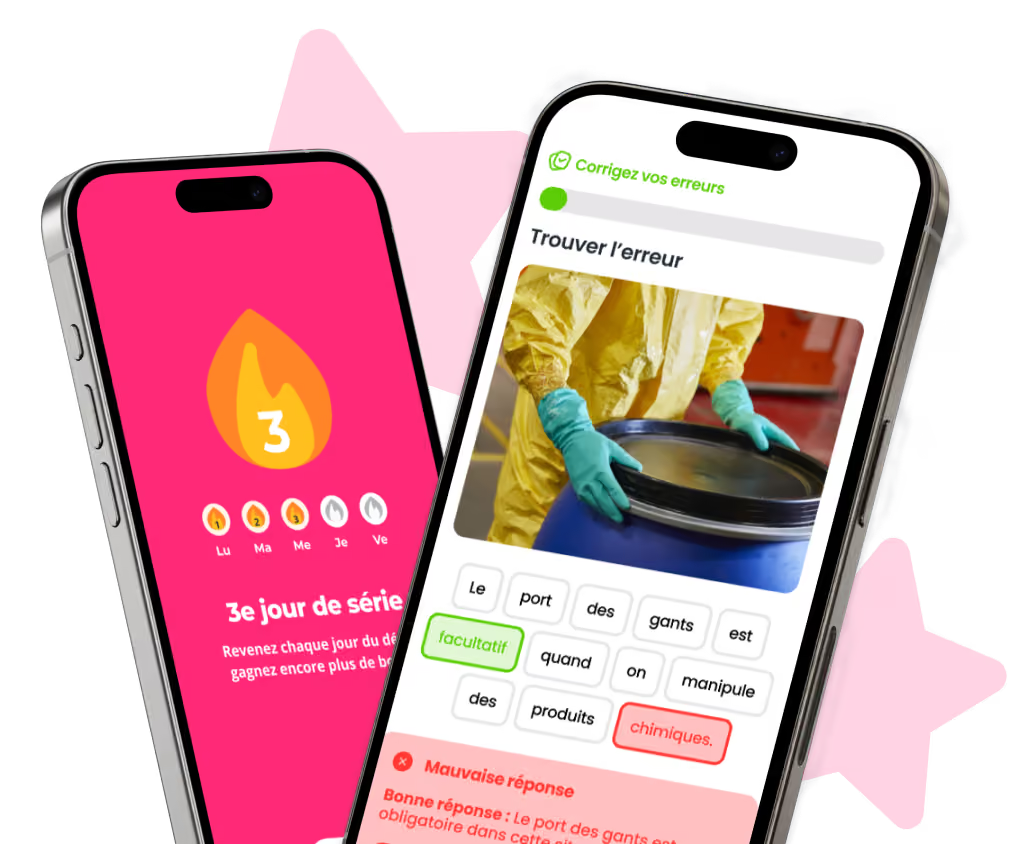
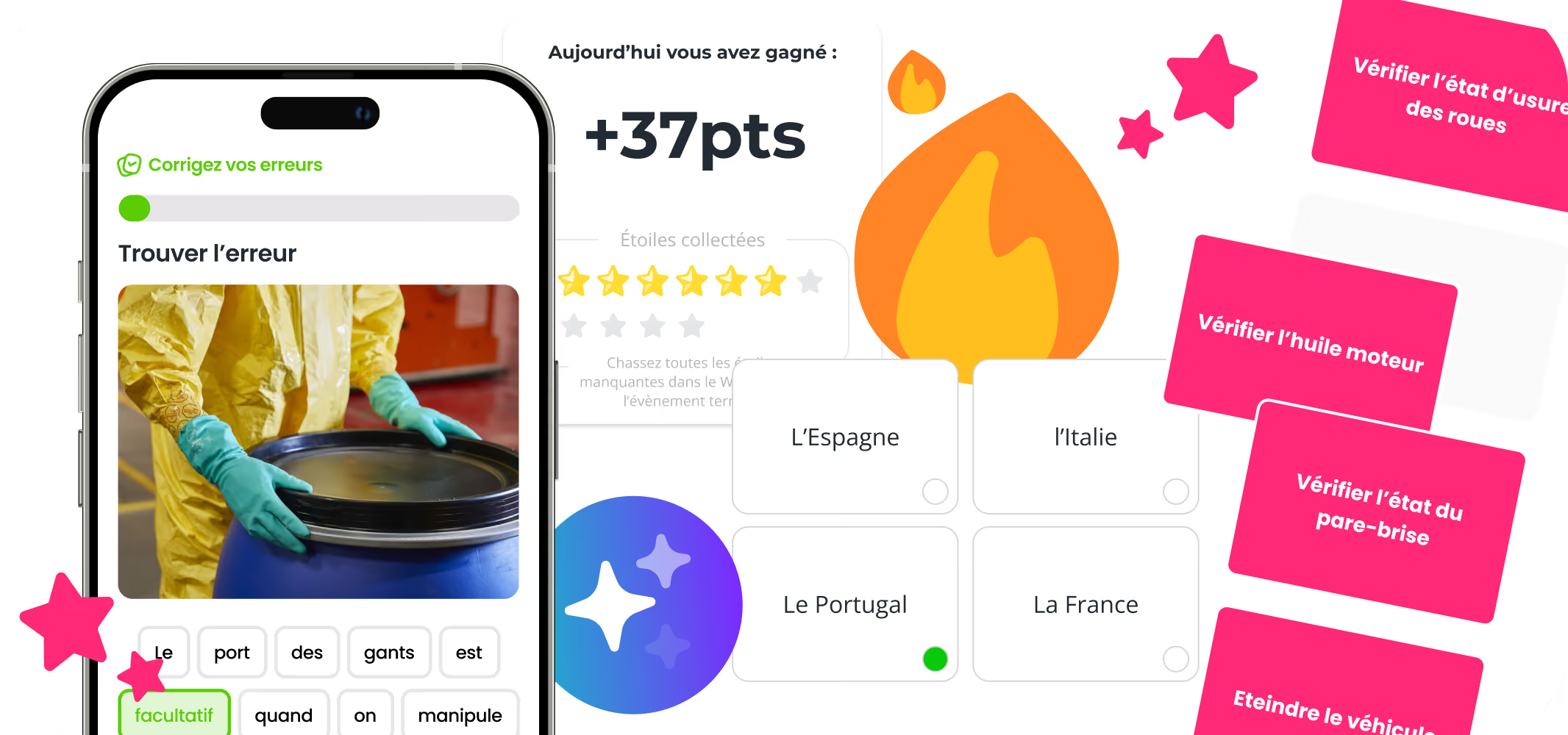
When it comes to format, anything is possible: videos, gamified questions, infographics. The deciding criteria remain the audience and the objective. SPARTED chose the short, playful question because it combines two effects: it triggers active recall, which strengthens memory, and it sustains engagement, which drives regular use.
Turning content into micro-content follows a simple progression. Gather your existing materials and sort them by topic. Highlight only the key information in each document, group it by subject and cut anything redundant. Then, for each point you keep, write a short question, a brief answer and a slightly more detailed explanation.
The cutting step is what determines the quality of the result, not the writing step. A course built on everything in the original material is no longer microlearning.
Deliver, engage and iterate
Launch happens through the tool you've chosen, but it is more than pressing a button. Communication before and after launch matters as much as the content, and facilitation throughout the campaign determines the real participation rate. The tool's built-in features then take over: the Question of the Day sends a daily notification on a piece of knowledge to review, which sets up a short ritual without any organizational effort.
Iteration is what keeps the program going. Repetition builds memory, but identical repetition gets boring. Switching game mechanics on the same micro-content varies the challenge while working on the same concept, and tests both what has been learned and what has been retained over time.
Additional content, such as infographics or short videos shared in the app, extends the same logic. This combination of regularity and variety separates a living program from a library of modules nobody opens, and it is what a mobile learning platform designed for continuous delivery makes possible.
Frequently asked questions
What is microlearning in simple terms?
Microlearning is training delivered in very short sequences, from 30 seconds to 10 minutes, each focused on a single learning objective. It is designed around the learner's attention and schedule rather than around the volume of content to cover.
How long should a microlearning module be?
Between 30 seconds and 10 minutes. This brevity avoids overloading working memory and lets training fit into the short windows of a workday. Beyond ten minutes, it is no longer microlearning in the usual sense.
What are the benefits of microlearning for employees?
The main benefits are stronger engagement, easier understanding thanks to chunking, and better retention through spaced reminders. It also suits deskless teams who have no fixed workstation, and it lets training teams build and update courses much faster.
Is microlearning the same as mobile learning?
No. Microlearning describes the format (short content), while mobile learning describes the device (the smartphone or tablet). The two are often combined, but you can do microlearning on a computer and mobile learning with long modules.
Is microlearning effective for complex skills?
Not as the main format. Mastering complex software or a technical process requires continuous practice and detailed explanations. Microlearning works best there as reinforcement after in-depth training, with targeted reminders that keep key points from being forgotten.


Need a mobile learning solution?
A simple, fast and engaging solution, up and running in under 2 weeks.
Discover our solutionTrain your teams in just a few minutes a day
Deliver short, gamified sequences to your employees' phones, and track each team's progress.
Book a demoGuide How to measure the ROI of your frontline training
Concrete calculations, proven methods and field examples to justify your training investment to leadership.
Read the guide →Need a mobile learning solution?
The simple, social and gamified solution, up and running in under 2 weeks.
Discover our solution