



Key takeaways
- Digital learning is the umbrella term; e-learning and mobile learning are two of its forms.
- Long formats (scripted modules, virtual classrooms) build complex skills; short formats (microlearning, quizzes, video clips) keep knowledge fresh and are fast to update.
- Social and game-based formats drive engagement without requiring more content.
- The real benefits are coverage of the whole workforce and management by usage data, not by attendance sheets.
- For frontline teams, a mobile approach is what makes digital learning reach people at all.
Digital learning is any form of learning that relies on digital technology, whatever the device, the session length or the level of human support: e-learning modules, virtual classrooms, mobile microlearning, videos, quizzes and internal wikis all count. It is broader than e-learning, and its main benefit for companies is reaching employees that classroom training never fully reaches, while measuring what they actually learn.
The term shows up in almost every training RFP, often without everyone meaning the same thing. For some, digital learning means a catalog of online modules. For others, it covers every digital tool that supports skill building, from the LMS to video to team rituals.
This vagueness is not just a vocabulary issue: it regularly leads companies to buy a platform that answers a different need from the one they had in mind. Many organizations have invested heavily in digital learning in recent years, with mixed results. Completion rates remain the most discussed pain point among training managers, and the diagnosis is almost always the same: the content exists, the platform works, but part of the workforce never opens it. The problem is not technical, it is about usage.
This article clarifies what digital learning covers, reviews the main families of formats and what they are used for, then looks at the concrete benefits observed in companies and the conditions that make them possible.
What is digital learning, really?
Digital learning covers every learning experience delivered through digital technology. Understanding how it differs from e-learning, and what has changed since the first platforms, helps you buy the right tool.
A definition broader than e-learning
Digital learning refers to all learning programs that rely on digital technologies, regardless of device, length or level of human support. It includes traditional e-learning, but is not limited to it. A live virtual class, a video clip watched on a smartphone between two customers, an internal wiki fed by business teams, a three-minute daily quiz: all of these are digital learning.
The confusion with e-learning comes from history. In the 2000s, digital training mostly took the form of the SCORM module: linear content of thirty to sixty minutes, taken on a computer and ending with a final test. This format shaped practices and vocabulary for so long that it ended up absorbing them. Many training managers still say "e-learning" for any training that doesn't happen in a classroom.
The distinction has practical consequences. If you equate digital learning with e-learning, you try to convince employees to spend an hour in a row on a module, which works poorly for a large part of the workforce. If you accept a broader definition, you can build a program that combines several time frames and levels of effort, and that fits into real work instead of interrupting it.
This broader view also changes the question you ask vendors. You no longer ask "what catalog do you offer?" but "which formats can your solution deliver, and to which populations?" That shift alone often removes half the candidates from a shortlist.
What has changed since the first platforms?
Three shifts have deeply changed the landscape. The first is the move to mobile. A large share of the employees trained today have no assigned workstation: sales associates, mobile technicians, production operators, care staff, drivers. According to Emergence Capital (2020), deskless workers make up about 80% of the global workforce. For them, access comes before any teaching consideration. An excellent platform that can only be reached from a shared computer in the back office will not reach them.
The second shift concerns content length. Research on memory and cognitive load, popularized by Hermann Ebbinghaus's work on the forgetting curve, has legitimized short, repeated formats. Microlearning is no longer a marginal option but a core building block of many programs, especially to reinforce learning after a classroom session.
The third shift is about data. Today's platforms produce usage indicators that go far beyond the simple completion rate: login frequency, correct answer rate by topic, progress by site or team, time between sharing a piece of information and its consultation. Managing by actual usage, rather than by self-reporting, is probably the most significant change of recent years for training departments.
These three trends reinforce one another. Mobile makes frequency possible, frequency produces usable data, and data lets you adjust content instead of running it unchanged year after year.
Digital learning vs e-learning vs mobile learning: what's the difference?
To clarify usage, it helps to compare the three most often confused notions on a few simple criteria: scope, main device, typical session length and the population each one naturally serves.
| Criterion | Digital learning | E-learning | Mobile learning |
|---|---|---|---|
| Scope | Umbrella term, covers all digital learning programs | Structured modules delivered online, often in SCORM format | Programs designed to be used on a smartphone |
| Main device | Any device, including blended setups | Computer, web browser | Mobile app, notifications |
| Session length | Variable, from 2 minutes to several hours | 30 to 60 minutes on average | 2 to 5 minutes |
| Target population | All employees | Support functions, employees with a desk | Frontline, mobile and multi-site teams |
| Key strength | Flexibility to combine formats | Depth and traceability of courses | Frequency, accessibility, regularity |
These three approaches are not mutually exclusive. A solid program often relies on long modules for core job fundamentals, and on short mobile formats to maintain the level between two sessions. The question is not which side to choose, but which format to assign to what it does best.
Digital learning formats and what they are used for
Digital learning formats fall into three families: long formats to build complex skills, short formats to reinforce and update knowledge, and social formats to drive engagement.
Long formats: scripted modules, virtual classrooms, certification programs
Long formats remain relevant when you need to build a complex skill, teach a line of reasoning or deliver a recognized certification. A forty-five-minute scripted module can combine a demonstration, practical cases and a consistent assessment, which a short format cannot do.
The virtual classroom holds a special place. It keeps most of what makes in-person training effective, namely direct interaction and the chance to ask questions, while removing travel costs. However, it remains tied to the calendar: participants must be gathered at the same time, which is still hard for teams working in rotations or shifts.
The main limit of these formats is the cost of updating them. A good scripted module is a significant investment, and updating it means reworking the storyboard, the recordings and sometimes the business validation. Where the product range changes several times a year, this production cycle is too slow, and content becomes outdated before the whole target population has seen it.
That is why many organizations now keep long formats for stable foundations, the ones that change little from year to year, and handle news and updates through other means.
Short formats: microlearning, quizzes, video clips
Short formats meet a different need: maintaining a level, building reflexes and sharing information quickly. A thirty-second question asked every day for two weeks creates a spaced repetition effect that three hours of training in one go cannot reproduce, because memory depends as much on how often you recall something as on total exposure time.
The quiz is probably the most underrated format. Used as an assessment, it has only an administrative value. Used as a learning tool, with an immediate explanation of the right answer, it becomes an effective and cheap way to consolidate knowledge. Being tested is itself a way to learn: this is the testing effect, documented for decades in cognitive psychology (notably by Roediger and Karpicke in 2006) and widely used by mobile programs.
Finally, the video clip works well for technical gestures and demonstrations. Filming an experienced employee showing a procedure, in a well-framed thirty seconds, often works better than an animated module produced by an outside agency, because the context is familiar and the author is immediately credible.
The main advantage of short formats is how fast they can be produced and updated. A training team can create and share a series of questions within a day, which makes it possible to respond quickly to sales or regulatory news.
Social and collective formats
A third set of formats relies on group dynamics rather than on content alone. Social learning covers the ways employees learn from one another: comments, sharing best practices, answering questions asked by peers, recognizing contributions.
Game mechanics belong to this family as soon as they connect people. A leaderboard between teams, a head-to-head match between two players on the same set of questions, a shared goal to reach: these create a social reason to come back that doesn't depend on the content itself. It is a powerful lever, and often misused. A company-wide individual leaderboard discourages most participants, while a team leaderboard brings people together.
News formats complete the picture. A short update sent to everyone, readable in fifteen seconds, with the option to react, plays a role that neither the module nor the quiz plays: it signals that something is happening and gives people a reason to open the app that day.
The value of these social formats is that they drive engagement without requiring additional content. They reuse existing content by changing the setting in which it is consumed.
What are the real benefits of digital learning for companies?
The two main benefits of digital learning are reaching the entire workforce, including people classroom training misses, and managing training with usage data. Both only materialize if the program fits how employees actually work.
Reaching people that classroom training doesn't
The first benefit, and the most measurable, is coverage. In a network of two hundred stores, organizing an in-person session for every sales associate takes several months and a large travel budget. It also inevitably leaves out part-timers, seasonal staff and anyone absent on the day.
A well-designed digital program removes these constraints. It still has to be truly accessible, which raises two concrete questions: what equipment is available, and when people can use it. If the program requires a computer, it excludes the same people as classroom training. If it requires thirty consecutive minutes, it excludes those whose work is fragmented.
This is exactly where training frontline teams differs from training support functions. The constraint is not motivation, it is format. Sales associates who are deeply committed to their job won't open a one-hour module, but will gladly answer three questions about a new product before the store opens.
Actual coverage, measured across the entire target population rather than only among enrolled learners, is therefore the most honest indicator to judge a digital program. It is also the one most often missing from reports.
Managing with data rather than attendance sheets
The second benefit is management. An in-person session produces a list of attendees. A digital program produces a map: who viewed what, how often, with what success rate, which topics concentrate errors, which sites are falling behind.
This data changes the conversation between the training team and operations. For example, seeing that one store has a 45% correct answer rate on a recently launched range, while the network average is 72%, makes a targeted action possible. That is a very different use from compliance reporting, and much more useful to the business.
The indicators still have to be the right ones. The completion rate, the historical metric, says little: it measures compliance with an instruction, not the skill acquired or how regularly people use the program. Organizations that get the most value from their data track usage frequency, the progress of correct answer rates over time and the gaps between sites. This topic deserves its own article: see our guide on measuring the ROI of a mobile program.
One caveat: data is only worth something if someone looks at it and acts on it. Many programs produce rich dashboards that nobody opens, because no owner and no review rhythm were defined.
Digital learning in the field: what a mobile approach changes
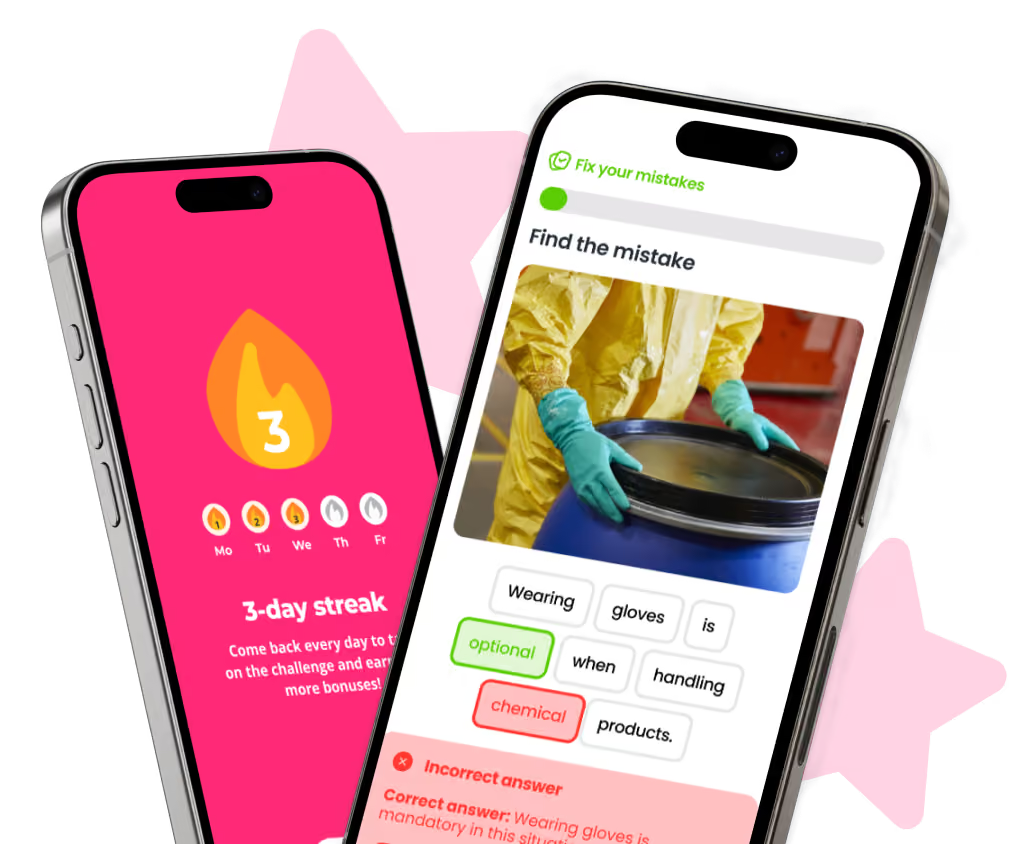
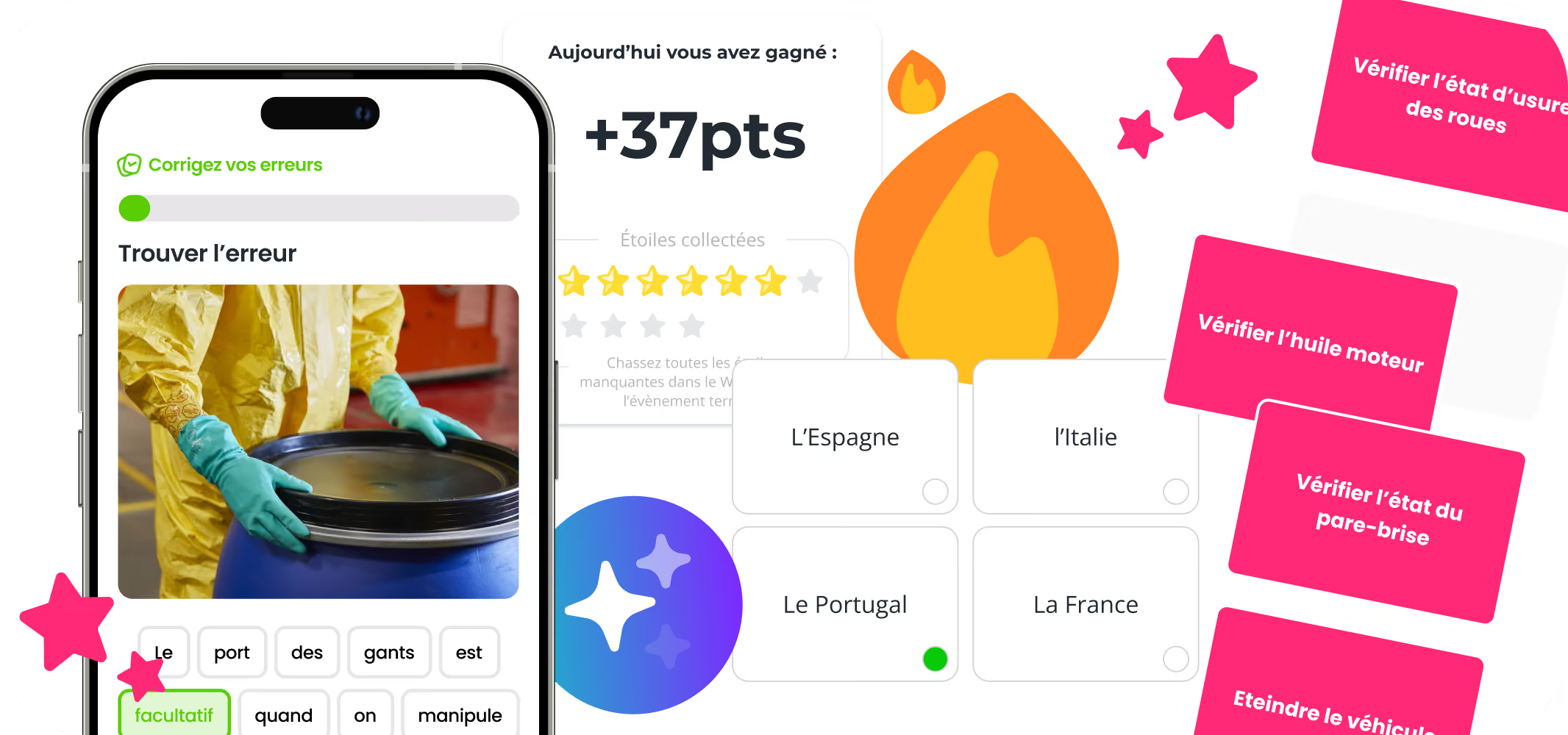
For organizations where most of the workforce works away from a desk, the mobile approach is not one format among others: it determines whether the program exists at all. This is SPARTED's approach: an app installed on the employee's smartphone, three-minute sessions, game mechanics and a social dimension that give people a reason to come back every day.
In practice, the employee receives a notification, opens the app, answers a few questions and gets explanations. They can read internal Breaking News, look up information in the Wiki, challenge a colleague to a Battle or follow their team's progress on the Leaderboard. All of this fits into a break, which removes the trade-off between working and learning.
On the management side, the Back Office gives training teams and network managers visibility by audience, topic and site: who plays, who progresses, where the knowledge gaps are. Content is produced and updated quickly, so it can keep pace with real product launches or procedure changes, without going through a long production cycle.
This approach does not replace long formats where they are relevant, and it doesn't claim to. It handles what long formats handle poorly: regularity, news, and access for the people traditional programs never fully reach. The resulting learning approach relies less on the number of hours than on the consistency of the ritual.
Frequently asked questions
What is the difference between digital learning and e-learning?
Digital learning is the umbrella term for any learning that uses digital technology. E-learning is one of its forms: structured online modules, often in SCORM format, usually taken on a computer in sessions of 30 to 60 minutes. Mobile microlearning, virtual classrooms and video clips are also digital learning, but not e-learning in the traditional sense.
What are the main digital learning formats?
The main formats are long formats (scripted e-learning modules, virtual classrooms, certification programs), short formats (microlearning, quizzes, video clips) and social formats (peer sharing, team challenges, news feeds). Long formats build complex skills, short formats reinforce knowledge and are quick to update, and social formats drive engagement.
What are the benefits of digital learning for employees who don't work at a desk?
For frontline and deskless employees, digital learning makes training accessible where they work, in short sessions that fit into a break. It avoids travel and scheduling constraints, reaches part-timers and seasonal staff, and gives managers data on knowledge gaps by site or team. This only works if the format is mobile and very short.
How do you measure the success of a digital learning program?
Completion rates alone say little. More useful indicators are the share of the target population actively using the program, usage frequency, the progress of correct answer rates over time, and gaps between sites or teams. These metrics show whether employees are actually learning, not just ticking a box.


Need a mobile learning solution?
A simple, fast and engaging solution, up and running in under 2 weeks.
Discover our solutionTrain frontline teams in 3 minutes a day
See how SPARTED delivers short content on employees' smartphones, with analytics to track adoption site by site.
Book a demoGuide How to measure the ROI of your frontline training
Concrete calculations, proven methods and field examples to justify your training investment to leadership.
Read the guide →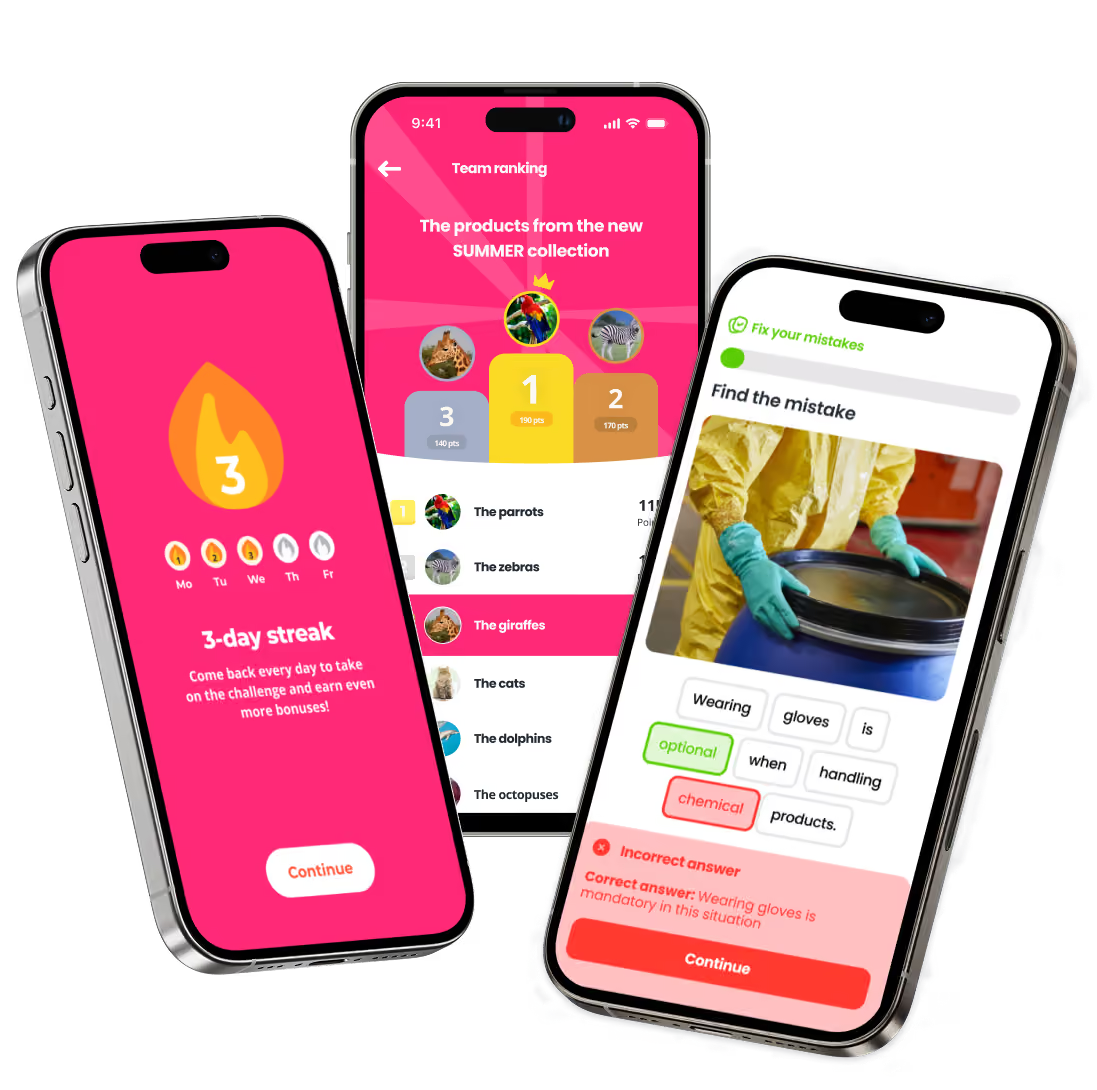
Need a mobile learning solution?
The simple, social and gamified solution, up and running in under 2 weeks.
Discover our solution