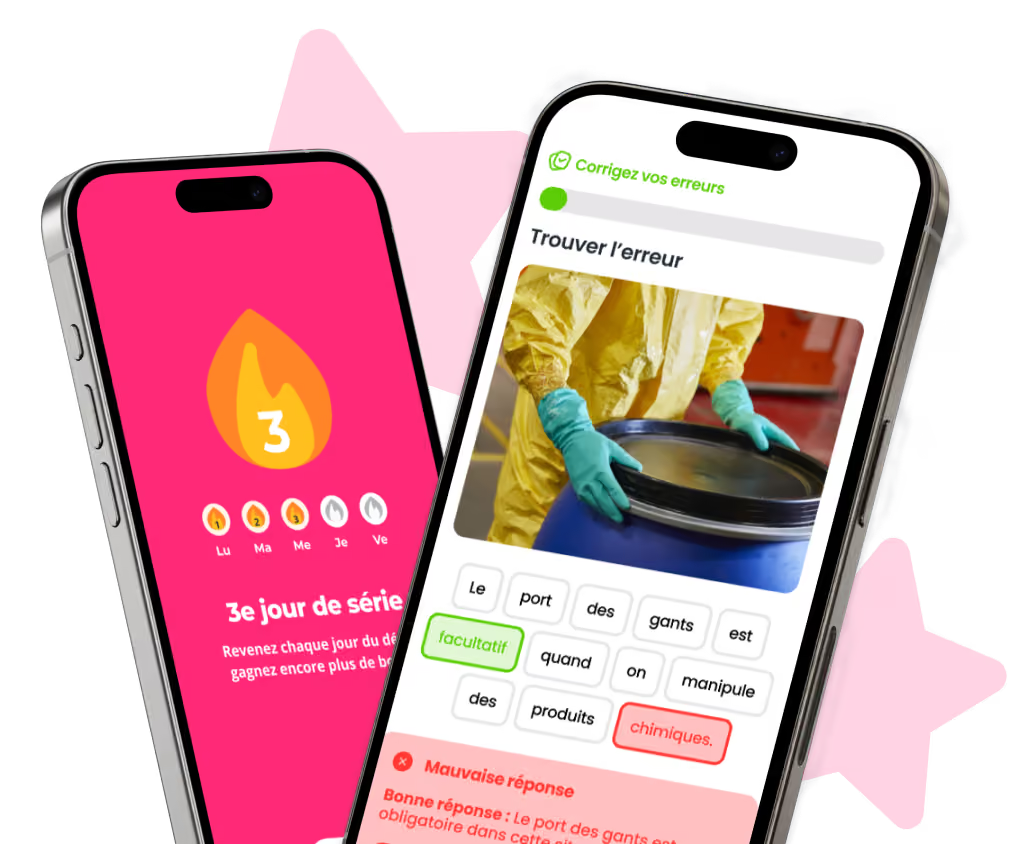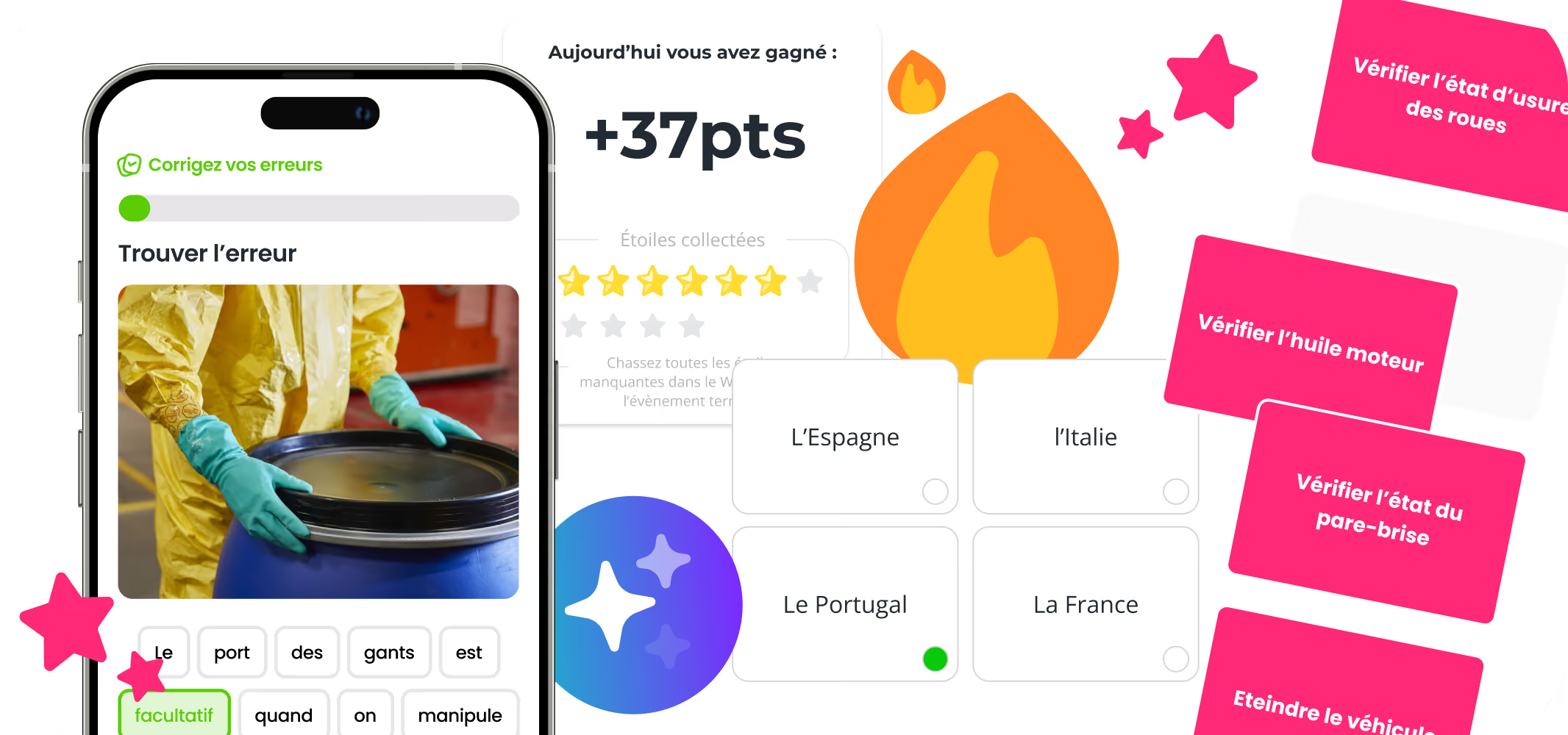








Training in 3 minutes a day works because learning depends more on consistency than on duration: short daily microlearning sessions, repeated at spaced intervals, consolidate knowledge in long-term memory. For busy and frontline employees, 3 minutes is also short enough to fit into the workday without interrupting operations.
Traditional training formats are showing their limits. Too long, too dense, too far removed from day-to-day operations, they struggle to fit into how employees actually work. Microlearning offers another path, built on brevity and regularity and on solid cognitive principles: spaced repetition, progressive retention, and engagement through simplicity.
By choosing ultra-short formats built into the workday, companies can turn training into a reflex, provided they choose the right tools, the right content and the right frequency. This is the bet we made at SPARTED, and it is what this article explores.
Key takeaways
- A 3-minute daily session lowers the barrier to entry, so training is actually completed.
- Short sessions repeated at intervals use spaced repetition, the memory principle first described by Hermann Ebbinghaus.
- Daily micro-sessions fit into existing routines: between two tasks, on a commute, at the start of a shift.
- The format suits frontline teams with no desk, no office and no dedicated training time.
- SPARTED limits each session to 3 minutes a day on mobile and links content to business priorities.
Why do short microlearning formats make the difference?
Short microlearning formats work because they match how attention and memory actually function: they reduce cognitive load, get completed more often and lend themselves to spaced repetition.
Attention is a scarce resource
Employees' days are saturated: back-to-back meetings, constant notifications, competing demands. In this context, it is unrealistic to expect to hold their attention through long training sessions. Even e-learning formats, although more flexible, struggle to keep learners interested once they run longer than a few minutes.
The answer is not to force it, but to adapt. By cutting sessions down to the essentials, you reduce cognitive load, lower the barrier to entry and, above all, increase the chances that the training is actually completed. Instead of trying to say everything at once, you gradually build lasting understanding.
The learning power of micro-sequences
Brevity is not the enemy of instructional quality. Short formats encourage focus and make it possible to structure messages with more impact. Better still, they align with a fundamental principle of human memory: spaced repetition.
Spaced repetition is the practice of reviewing the same content at increasing intervals so that it settles into long-term memory. Every interaction, even a 3-minute one, acts as a point of cognitive stimulation, and content reviewed regularly in different contexts is retained more firmly.
This is what we call progressive knowledge retention: learning that relies on consolidation rather than accumulation. Training becomes light, continuous and lasting practice, well suited to work environments where time is tight.
Building training into daily habits
One of the major strengths of daily micro-sequences is their ability to fit into existing routines. Where a one-hour session requires a trade-off in the calendar, 3 minutes slips easily between two tasks, into a commute, or into the start of the day.
This regularity creates a ritual. Training becomes a habit, a daily reflex, almost invisible but effective. Gentle, non-intrusive repetition sharpens attention, supports assimilation and creates long-term learning momentum.
Is 3 minutes a day enough to train employees?
Yes, for reinforcing knowledge and job reflexes, 3 minutes a day is enough when it is repeated consistently over weeks. The short session removes friction at the start, encourages repetition and adapts to frontline constraints.
Reduce friction at the start
One of the main barriers to training is not the content but the time it takes. As soon as a session goes beyond 20 or 30 minutes, it becomes a sticking point: you have to get organized, free up a time slot, concentrate. As a result, it is often postponed or dropped.
Training in 3 minutes a day solves this problem by reducing friction to a minimum. No need to plan, no need to step away. Employees can learn during downtime, on the move, or at their own pace. This instant accessibility is the key to buy-in: the lower the perceived effort, the easier it is to build consistency.
Encourage repetition and retention
This approach encourages repetition without redundancy. By breaking content into small pieces, you create step-by-step progress, where each session echoes the previous one while adding something new.
This drives retention through micro-reviews. The brain consolidates information through frequent reactivation rather than intensity. By revisiting a concept several times, from different angles and at strategic intervals, learners turn it into a professional reflex.
The method does not sacrifice depth, it builds it differently: through small, cumulative touches that add up without overloading cognitive capacity.
Adapt to frontline constraints
In many companies, especially in retail, manufacturing, logistics and services, employees have no desktop computer, no office and no formal time set aside for training. This is where mobile microlearning really comes into its own.
Training in 3 minutes a day makes it possible to:
- Deliver content to frontline, mobile or multi-site employees
- Guarantee equal access to learning for every profile
- Build skills without interrupting operations
It is a realistic answer to operational constraints, and also a strong signal of recognition: everyone can progress, whatever their context.
Why SPARTED made this choice, and why we adopted it ourselves
SPARTED limits each training session to 3 minutes a day on mobile because this format removes resistance to training and keeps usage regular over time.
Betting on maximum simplicity
At SPARTED, we have always held a strong conviction: training should never be an obstacle, but a spark. That is why we made a deliberate choice: limiting each session to 3 minutes a day, on mobile. Far from being a constraint, this format has become a differentiating strength.
This short duration removes every source of resistance: no dedicated time needed, no mental overload, no organizational effort. Users can learn whenever and wherever they want, on their own. This simplicity is what anchors training in daily habits.
What results does a 3-minute daily format produce?
Since we rolled out this format across the board, we have observed:
- Usage frequency well above the average for traditional LMS platforms
- A high completion rate, especially over cycles of several weeks
- Score improvements driven by repetition and self-correction
Beyond the numbers, feedback from the field confirms the approach. Users talk about sessions they "look forward to," "replay" or share with colleagues. Training becomes social and engaging.
Connecting daily learning to business impact
Training in 3 minutes a day is an approach focused on operational performance. By making learning smooth, embedded and regular, SPARTED brings training closer to the company's concrete priorities.
Every piece of content can be aligned with a specific business need: a new procedure, a sales behavior to reinforce, a regulatory change or a reminder of best practices. This ability to quickly adapt content to frontline needs keeps upskilling relevant, up to date and connected to the organization's goals.
Training thus becomes a direct extension of business strategy rather than an isolated HR program. It supports transformations, accompanies change and speeds up the spread of key messages, without slowing operations down.
This constant alignment between content, usage and objectives is what makes SPARTED a training tool that drives performance, not just a knowledge repository.
Frequently asked questions
Is 3 minutes a day enough to learn something?
Yes, for knowledge and job reflexes, provided the sessions are regular. Three minutes is enough to answer a few questions or review one concept, and repeating it daily over several weeks consolidates it through spaced repetition. It is less suited to learning a complex skill from scratch.
What is microlearning?
Microlearning is a training approach that delivers content in very short sequences, usually from 30 seconds to 10 minutes, each focused on a single objective. It is often delivered on mobile so employees can learn between tasks.
Why is daily training more effective than one long session?
Memory consolidates information through repeated, spaced reactivation rather than one intensive exposure. Daily short sessions also lower the effort needed to start, so employees are more likely to complete them and keep the habit.
How do you get employees to train every day?
Keep sessions very short, deliver them on the phone employees already carry, and send a daily notification at a predictable time. Game mechanics, progress tracking and manager involvement help turn the session into a routine.


Need a mobile learning solution?
A simple, fast and engaging solution, up and running in under 2 weeks.
Discover our solutionTrain your teams in 3 minutes a day
Short daily sessions on mobile, gamified and easy to follow. See how SPARTED builds lasting learning habits.
Book a demoGuide How to measure the ROI of your frontline training
Concrete calculations, proven methods and field examples to justify your training investment to leadership.
Read the guide →Need a mobile learning solution?
The simple, social and gamified solution, up and running in under 2 weeks.
Discover our solution